Showing posts with label formative assessment. Show all posts

Monday, 4 August 2014

Claiming back time

So, this Making Thinking Visible stuff sounds brilliant right? Something that makes explicit what we hope we are teaching by osmosis.

But how do we put that thinking stuff into place, in our time-poor, curriculum driven classrooms?

We all have deadlines to meet, outcomes to check off, programs to write - I know, I'm in the same boat. We are already trying to put too much stuffing into the bloated chicken that is teaching, and just when you think you've done it all, someone tells you to throw a fancy Masterchef style garnish on top too.

This is where the mindset shift for us as teachers is essential - by making thinking visible to ourselves and our students, we gain time in our classrooms.


Big call, I know. So, let's take a quick dip into the ocean that is Visible Thinking and make the thinking behind that statement visible, by using a Thinking Routine (a thinking strategy to encourage understanding - the basis of the teacher's toolkit of Visible Thinking).  
This is called Claim-Support-Question - a routine designed to consider all aspects of a statement (and a great one for encouraging critical thinking!).

So, the claim is: Making Thinking Visible allows teachers to gain time in classrooms.


What can we use to support this claim?
  • By using thinking routines, we are able to gain information about student thinking patterns, allowing for on the spot formative assessment 
  • Creating a Culture of Thinking encourages students to share their thinking and ideas, facilitating collaboration between peers and allowing for students to teach each other rather than direct teacher instruction
  • By making the thinking behind ideas visible, teachers explicitly teach students easy strategies to analyse concepts in depth, developing a deep knowledge and understanding of topics rather than a surface understanding that can be applied across disciplines.
Ok, sounds great right? But there is two sides to every story, and using this routine allows us to consider all aspects instead of blindly accepting the claim - a skill that we often wish to cultivate in our students.

What questions could we pose about this claim?
  • How about the time it takes to get started? Surely there is time that must be put into setting up these routines and cultivating the thinking needed?
  • What about the time needed to up skill staff in developing the language associated around routines? Who will do it and how?
  • What if my school already has a 'big idea' its pursuing? How can I fit Visible Thinking into previously established structures?
I'm sure there are others we can ask to pose against the claim. The short answer to all these? Time spent well is time gained. If we invest a teeny tiny bit of our time now in figuring out how to create a culture of thinking in our classrooms, we can be paid back ten fold in the time we gain from the collaborative and constructive environment Visible Thinking creates. 

The skills that we want students to develop as 21st Century learners - critical and creative thinking, questioning, risk taking, persevering, communicating, reflecting (this is starting to sound like the IB Learner Profile...) - are facilitated by deep thinking and become naturally embedded in our teaching through the use of the Routines. They are a teaching tool, not an extra activity.

Now that is brilliant. 
Find me online!
twitter: @bswain1
email:missswain24@gmail.com
pintrest:https://www.pinterest.com/bswain14

or comment below!


Saturday, 2 August 2014

That 'thinking' stuff


"My students are too young/too low/too busy. There is no way they can do this 'thinking' stuff"

In my class we have a rule when faced with a problem - RTQ x 2 (Read the Question Twice). So go on, read that above statement again.

Now, cut off the first part of that statement and focus on the second part.


"There is no way they can do this 'thinking' stuff"

Taken in isolation, that statement is a little bit ridiculous. Unless you're teaching a class of rocks, every single one of them is doing this 'thinking' stuff every minute of every day. ( Although, I'm sure your rock class might be doing it too - maybe you have the G&T rocks).

I'm the first to admit that when I came in contact with Visible Thinking, I saw the Thinking Routines as an activity that I could easily slide into my program, and then VOILA my students would be visible thinkers. I think this is an experience that is commonly shared by those first bitten by the VT bug. It's new, it's exciting, and we think it will be a bandaid that will cover all the 'thinking stuff' in our classroom.

If there's one thing (or one seashell) that I took away from Project Zero Classroom, it's that there is absolutely no point 'doing' Thinking Routines and then saying "Look! My student's thinking is visible, now let's move on." The process of Making Thinking Visible in learning is not something that  can be easily changed overnight, or just done once then moved on from. 

Making Thinking Visible in your classroom requires a mindset shift from you too.

Lev Vygotsky, advocate for constructivist-based pedagogy, is often quoted as saying:
 "Children grow into the intellectual life of those around them". 
In other words, the intellectual world we model for our students is what shapes their own perceptions of the value of thinking. If you don't value deep thinking, then your students won't either!

So, how do we start showing students that developing more than a surface understanding of concepts is vital to nurturing intellectual development? By creating a Culture of Thinking in our classrooms.

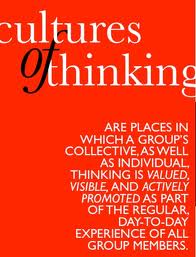
A concept coined by Ron Ritchhart, key researcher of the Making Thinking Visible project at Project Zero (Click here to learn more about Ron and MTV), a Culture of Thinking is a place where thinking is visible, valued and actively promoted for all members.

Let's break that down further.

In order to create a Culture of Thinking - an environment where children understand the importance of deep understanding and intellectual fluency, we need to consider the three concepts in isolation.

Thinking is Visible - Assessing understanding of abstract concepts, or things that can't be measured through a test score is tricky. So how the %$!* do we assess thinking? By making thinking visible, the process of developing understanding is made accessible to both teacher and students, as well as parties outside the classroom. Teachers are able to garner the thinking process students are undergoing (which is great for formative assessment!) and students are able to reflect on their process of understanding.  Most importantly, all parties get insight into how the learning is occurring.

Thinking is Valued - Why do your students not put up their hands when you know they have a pretty good idea of the  answer? Well, number one, you might be asking the wrong kind of question, but, in addition, is students do not feel their thinking is valued, they aren't going to put their necks out to risk humiliation. A Culture of Thinking in a classroom values the process and effort of developing understanding, and encourages students to share their thinking practices with others, even if their thinking is not yet fully developed. It encourages students to share their steps towards developing a full understanding, and encourages the idea that mistakes are just stepping stones in thinking.

Thinking is Actively Promoted - There is no such thing as no time for thinking. Every interaction, every discussion, every question is an opportunity to promote and encourage  students to share their thinking. Talking about thinking, sharing thinking, reflecting on thinking - we encourage this naturally through our teaching, but we need to do it consciously and purposefully and, more importantly, we need to make it visible to our students.


I know right. It makes a lot of sense. It's ok. Take a second to push those brains back inside your skull and regroup. I know I needed too when the VT bus first hit me. Head on collision. Brains everywhere.

So the next big question is how. How do we create a Culture of Thinking in our learning environments? (whether it be classrooms, schools, districts, homes or other educational settings) Lucky, Ron hasn't left us in the lurch. He and his partner in crime Mark Church have teamed up to give us a whole lot of resources to help us make thinking visible, which I'll run through over my next few posts.

Now, as all great members of my class do, RTQ x 2. Go back and read that again so you can start thinking about your thinking, and how valued, visible and actively promoted thinking is in your learning environment. 

As always, feel free to comment, email me (missswain24@gmail.com) or tweet me (@bswain1) with questions, queries or comments. :)

Thursday, 29 May 2014

A little unhinged

No, this is not a hilarious reference to my mental state at the moment. I'm more like this:


Actually, I'm lucky to be participating in a Teacher Learning Community (TLC) this year - a group of teachers all reflecting upon our pedagogy and researching current trends associated with formative assessment (or Assessment for Learning).


A TLC is based in the research of the wonderful Dylan Wiliam, who maintains that formative assessment and feedback are tools for learning that have a massive impact on student achievement; a sentiment supported by John Hattie, who notes a 0.72 effect size on achievement. 


(For those not in the know, thats MASSIVE. An effect size of 0.4 is equal to 1 years academic growth. Feedback has an effect size of almost double that!)

Hattie's Barometer of effect sizes
In our TLC, we share success and failures, celebrate achievement and are constantly looking to improve our practice so to engage students in their learning. We bravely go where no teacher (at our school) has gone before - trying out new techniques and working collaboratively on seamless integration of content into previous programming.

My area of focus at the moment? Hinge questions!


Hinge questions are a tool that can be used about halfway through a lesson to gauge student understanding. Usually presented in a multiple choice format, they act as a reflection point for students, but also a pedagogical road map for the teacher to direct future learning.


BUT....these are no regular questions!


Hinge questions not only assist in determining whether students understand the content, but also allow a teacher to consider a student's cognitive decision making process, and the thought patterns behind selecting a certain response. It's not about getting the only answer, its about determining which answer is most correct, and justifying why.


Awesome, right?

Taylor Swift really loves a good hinge question.
So as I began my hinge question quest, I started by doing some research into what makes a real cracker of a hinge question - because if I was going to do this, I wanted to do it right.

I found they were a little more complicated that I initially thought - in fact the 'hinge' questions I had been posing to my students were a little unhinged - they weren't really giving me the feedback I needed for my teaching.


I stumbled across this post by Sally Heldsinger on Assessment Community that really broke down what a great hinge question should entail. She notes that hinge questions should show a student's developing understanding of a concept, so by considering their answers, we can see the depth of understanding the student has about a given topic.


She also had this lovely quote from Margaret Heritage (2010), that I really think encapsulates the importance of feedback:


'...Assessment is not unidirectional, but rather involves both teachers and students in a reciprocal activity to move learning forward within a community of practice. This reciprocal activity is characterised by teachers and students engaged in responding to evidence about learning, minute-by-minute, day-by-day, through the provision of scaffolding, self-monitoring, and self regulation on the part of the students'

I love the idea of assessment being a symbiotic relationship - it is an activity that benefits both parties, and enriches our understanding of the other's purpose in the teaching-learning relationship. Unfortunately, I think this ideal is somewhat lost  in the typical 'assessment for assessment's sake' ideology that is all too present in schools currently. 


I know it sounds all butterflies and unicorn farts - too idealistic, overly optimistic for your everyday school - but if we can do it in classes we've fondly nicknamed 'The Behaviour Unit', then I think it's possible anywhere.


I'm still on a journey of discovery with hinge questions, so if you have any insights, discoveries or burning questions, share below!


Monday, 24 March 2014

Formatively Fantastic

Before I get into the intelligent smarty pants stuff, on a side note - 
WHAT IS IT WITH KIDS AND WEATHER??
The temperature drops a couple of degrees = DRAMA
It's windy = CHAOS
It's raining = CABIN FEVER

Here is an short informative clip that demonstrates my classroom during wet weather:


Anddddddd we return to our scheduled programming.


I have mentioned before here that our school is a bit nuts for formative assessment. We very rarely use summative assessment, as the way I interpret it, the students don't really need end of unit/term/year assessments because we are constantly assessing them, and they are constantly assessing themselves (Don't quote me on that - it's just my interpretation).


I knew all about formative assessment in university, but it wasn't until I started teaching that I really picked up some great strategies to feed up, back and forward to my students. Our students can articulate what they're learning, why its important and where to next - real metacognition in action!


So here they are, my top 5 formative assessment strategies for a cross stage classroom: (or any classroom for that matter, but mine is cross stage and it sounds fancy, so there.)


1. Mini whiteboards

Using a mini whiteboard is a great tool, because not only does it get students directly involved with any modelling you are doing, but it also allows you to find out, on the spot, whether students understand what you are talking about and allows you to change your practice accordingly. 
Example? Today when teaching rounding in maths, I asked students to round a 3 digit number to the nearest 10. about 50% of students got it right. I remodelled in a slightly different way, and all students were then able to get it right and justify their response (linking in with our success criteria).


Disclaimer: This is not my class. I thought I had pictures of kids using whiteboards on my phone but I was oh so wrong. Please enjoy this image of some class somewhere using formative assessment.

There's deep thoughts on them. BEWARE!


2. Exit Slips
Exit slips are a form of summative-formative assessment in a way, as they are usually completed at the end of a lesson as a form of reflection upon learning, or as a chance to ask further questions. I like to get kids to post them on my door as they literally 'exit' the classroom.  It's fantastic to see whether students have grasped a concept, or if they need help in certain areas. They can be anonymous, or have names, depending on the task. I usually either give students a deep thinking question or a visible thinking routine (more on these later) to really challenge their thinking.


3. Bump it Up
Bump it up walls are BRILLIANT. They get students to reflect on their learning in a particular activity - in this case independent reading - and rate themselves against criteria that they have created! It reinforces the concept of 'where to next' - what kids need to do next to become better readers. This is actually my wall from last year, as again, I didn't have a photo of this year's, but you get the picture.
If students are consistently achieving the top level, I like to get them to create the next level up so they have something to work towards as well.


4. Individual Goals

Individual Goals, whether set by the teacher or by the students, are a great way for students to work towards a specific criteria that they need to focus on. These  goals are worded in kid-speak, but still use any relevant metalanguage to develop student vocab. I check the reading goals during guided reading groups and remind students of them constantly. Writing goals, however, are monitored by a student's thinking partner - their buddy for a fortnight who they share their thinking and learning with.


5. And last but not least...LISC

Learning Intentions and Success Criteria are absolutely essential to any lesson. It tells the students what we are learning about, why and what they need to do to achieve it. They're simple, taken straight from the syllabus, and give students a focal point for learning.
WILF = What I'm looking for - your expectations
TIB = This is because - real life connection for learning
WALT/WALA = We are learning to/we are learning about


There obviously are many others that are absolutely fantastic - this is not an all inclusive list of what I use in my classroom, I also show much love for thumbs up/down, paddle pop sticks, wait time, reflection statements, Think-Pair-Share etc.... but we would be here all day and you would find it as boring as batpoop. 


(nice simile, huh? Wouldn't mind seeing that in some student writing...)


Do you use formative assessment in your classroom? What's your go to strategy?